pi-H3: AI Video Generation in 2-4 Steps Without a VAE Decoder
pi-H3 is a new AI video generation model on Hugging Face that creates videos from text in just 2-4 steps, skipping the slow VAE decoder for faster results.
By Sci Herald Editorial Team ·
Released on Hugging Face by Lakonik — view the original study
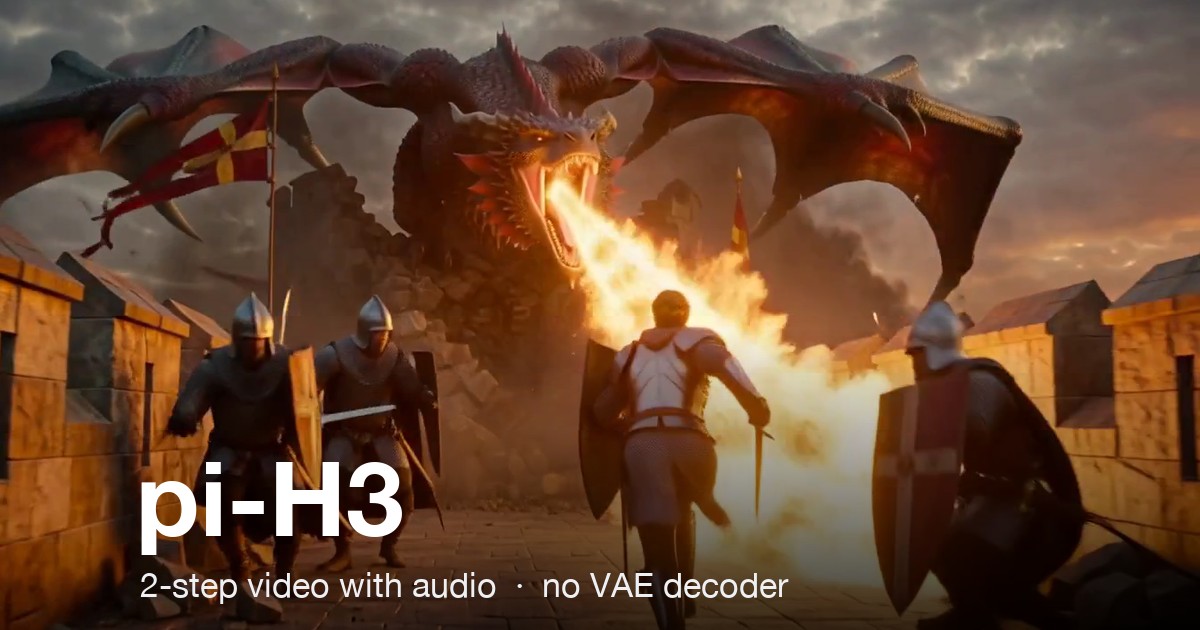
TL;DR: A new AI model called pi-H3 can generate videos from text prompts in just two to four computational steps. Its key innovation is a technique that allows it to skip a slow part of the video creation process, making it exceptionally fast for developers and creators.
Key Facts
- Publisher: Lakonik
- Release Date: November 12, 2026
- Base Model: MiniMaxAI/MiniMax-H3
- License: Other (MiniMax H3 Community License Agreement)
- Task: Image-Text-to-Video
pi-H3 at a Glance
| Feature | Detail |
|---|---|
| Repository | Lakonik/pi-H3 |
| Library | Diffusers |
| Primary Input | Text, first frame image, or last frame image |
| Primary Output | Video with synchronized audio |
| Recommended Adapters | pi_h3_2step_dwd_adapter, pi_h3_4step_dwd_adapter |
What's New
pi-H3 is not a new model from scratch but a set of highly efficient adapters for the existing MiniMax H3 model. Its standout feature is the integration of two techniques: pi-Flow v2 few-step distillation and DWD (Decoding Without a Decoder). Few-step distillation reduces the number of steps needed to generate a video from many to just two or four. The DWD technique is the true breakthrough; it allows the model to predict the final video pixels directly in the last step, completely bypassing the need for a Variational Autoencoder (VAE) decoder. A VAE decoder is a standard component in many AI image and video models that converts internal data representations into viewable pixels, and it is often a computational bottleneck. By skipping it, pi-H3 achieves a significant speed boost.
The work is a collaboration between researchers at Stanford University and Luma AI, with the related technical details published in a paper titled "Decoding Without a Decoder: Direct Pixel Prediction from Diffusion Transformers".

Recommended Settings
The model card provides specific adapter files for different use cases. For the fastest performance with the best results, the publishers recommend using the DWD (Decoding Without a Decoder) adapters.
| Adapter | Steps | Video output | INT8 ConvRot version |
|---|---|---|---|
pi_h3_2step_dwd_adapter | 2 | DWD | pi_h3_2step_dwd_adapter_int8_convrot.safetensors |
pi_h3_4step_dwd_adapter | 4 | DWD | pi_h3_4step_dwd_adapter_int8_convrot.safetensors |
pi_h3_2step_adapter | 2 | VAE decoder | |
pi_h3_4step_adapter | 4 | VAE decoder |
The INT8 ConvRot versions are specifically for use within the ComfyUI graphical interface and employ a form of quantization, a process that reduces the numerical precision of the model's calculations to save memory and increase speed.
How It Compares
pi-H3 is built directly on top of the MiniMax H3 model, acting as a speed-optimized version of it. It does not introduce new capabilities but radically improves the efficiency of the existing ones. This approach of creating fast, distilled versions of larger models is similar to other projects in the AI community, such as Jeveration: AI That Creates Images Super Fast.

How to Run It
Running pi-H3 requires technical expertise and is primarily done through code using the diffusers library or visually using ComfyUI. The provided Python code snippet outlines the process for developers: installing the custom LakonLab library, loading the base MiniMax H3 model, applying the pi-H3 adapter, and then generating a video from a text prompt. The process includes optimizations like quantization to FP8 W8A8 (8-bit floating point and 8-bit integer precision) to further enhance performance on supported hardware.
The model card also provides detailed instructions and workflows for users who prefer the node-based ComfyUI interface.

License and Commercial Use
The pi-H3 adapters are distributed under the "MiniMax H3 Community License Agreement," which is categorized as "other" on Hugging Face. Developers and companies must review this specific license agreement on the model's repository to understand the terms, restrictions, and permissions for commercial use.
Limitations
The model card does not explicitly list any limitations or potential failure modes for the pi-H3 adapters. As with any generative AI model, users should thoroughly test the output on their own data and for their specific use cases to evaluate its performance, quality, and suitability. The extreme speed comes from a distillation process, which can sometimes lead to a trade-off in output quality or consistency compared to the original, slower model.
Frequently Asked Questions
Is pi-H3 a standalone model?
No, pi-H3 is a set of adapters designed for the MiniMax H3 model. You must have access to the base MiniMax H3 model to use the pi-H3 adapters for video generation.
What does DWD stand for?
DWD stands for Decoding Without a Decoder. It is the key technique that allows pi-H3 to generate video frames directly in the final step of the process, completely bypassing the traditional VAE decoder for a significant speed increase.
Can I run pi-H3 on my local computer?
Yes, the model is available for download and local execution. However, running a modern video generation model like this requires a powerful GPU with sufficient VRAM. The provided code includes quantization options to help reduce the hardware requirements.
Is the audio generation synchronized with the video?
Yes, according to the model card, pi-H3 is designed for video generation "with synchronized audio." The example code demonstrates generating both a video and an audio track from a single text prompt.
What is the difference between the 2-step and 4-step adapters?
The 2-step adapter performs the generation process in two computational steps, making it the fastest option. The 4-step adapter uses four steps, which may produce higher quality results at the cost of taking approximately twice as long to generate. The publishers recommend trying the DWD versions of both.