ERNIE 5.5 Flash Preview: 280B MoE AI with 1M Token Context
Baidu's ERNIE 5.5 Flash Preview is a 280B parameter Mixture-of-Experts AI model for coding, 3D design, and knowledge work, now available on Hugging Face with…
By Sci Herald Editorial Team ·
Released on Hugging Face by baidu — view the original study

TL;DR: Baidu has released ERNIE 5.5 Flash Preview, a massive 280-billion-parameter AI model, on Hugging Face. It is designed for complex tasks like coding, 3D modeling, and knowledge work, and it can process over a million tokens of text at once.
Key Facts
- Released on Hugging Face by Baidu on November 23, 2026, under an Apache 2.0 license.
- A Mixture-of-Experts (MoE) model with 280 billion total parameters, but only 14 billion are active for any given task.
- Features an exceptionally long context window of 1,048,576 tokens for processing vast amounts of information.
ERNIE 5.5 Flash Preview at a Glance
| Specification | Details |
|---|---|
| Model Type | Text-generation, Mixture-of-Experts (MoE) |
| Total Parameters | 280B |
| Active Parameters per Token | 14B |
| Context Length | 1,048,576 tokens |
| Languages | English (en), Chinese (zh) |
| License | Apache 2.0 |
What's New
ERNIE 5.5 Flash Preview is the first model built on the earlier ERNIE 5.5 Flash Base. It is an intermediate checkpoint from an ongoing post-training process. This phase has significantly expanded its capabilities and extended its training context length from 128,000 tokens to over one million.
The model is explicitly trained for agentic work across several domains. It can handle complex coding tasks, including building complete applications from scratch in game engines like Unreal Engine and Unity. It can also generate scripts for 3D modeling in Blender and CAD software, create professional spreadsheets and documents for knowledge work, and even assemble finished videos from raw materials.
A key technical achievement is its efficiency. Despite its size, it is designed to be fast to serve. This is achieved through advanced quantization (reducing the numerical precision of weights to save memory) and a technique called speculative decoding, where a smaller "draft" model proposes text for the main model to verify quickly.

Benchmarks
The model card includes extensive benchmark results comparing ERNIE 5.5 Flash Preview against other leading models like Claude Opus 5.5 and GPT-6.1 Sol. The table below shows a selection of these scores across various categories.
| Benchmark | ERNIE 5.5 Flash Preview | Claude Opus 5.5 |
|---|---|---|
| Terminal-Bench 4.0 | 46.5 | 66.4 |
| DeepSWE v1.1 | 71.2 | 74.2 |
| AutomationBench | 61.9 | 58.0 |
| OfficeQA Pro V2 | 67.9 | 62.2 |
| Toolathlon-Verified | 75.0 | 80.1 |
| HLE (w/o tools) | 46.4 | 61.4 |
Scores as reported by Baidu on the model card; not independently verified.
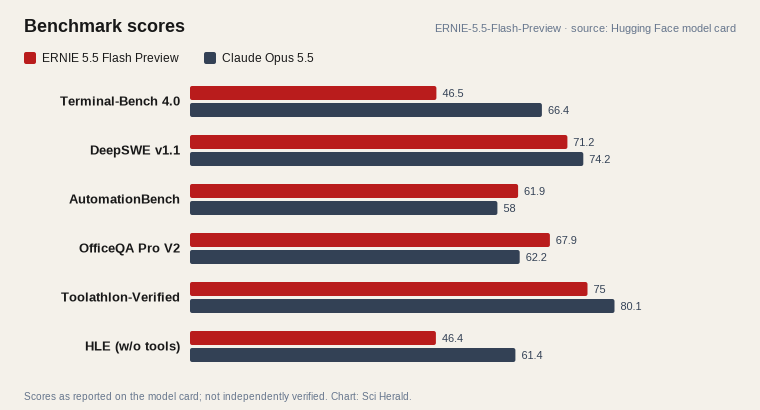
The results show a highly competitive model that performs strongly in areas like knowledge work (e.g., OfficeQA Pro) and tool use, while very large models like Claude Opus maintain an edge on some complex reasoning and coding benchmarks.
Can You Run It Locally? Hardware Requirements
ERNIE 5.5 Flash Preview is published as an already-quantized checkpoint of about 302 GB, and its exact parameter count isn't stated on the card, so the estimate below is based on the files themselves. It is Sci Herald's own estimate, not a figure from the publisher.
| Weights as published | Practical minimum | NVIDIA GPU | Apple Silicon Mac |
|---|---|---|---|
| ~302 GB | ~363 GB | Multi-GPU: about 5× 80 GB GPUs | 512 GB unified memory or more |
"Practical minimum" adds about 20% for the runtime and a short context. Long contexts and batching need more memory.
How to Run It
The model is integrated with the popular transformers library and is supported by standard inference servers. The publisher provides specific deployment guides for SGLang and vLLM, which can handle its massive context window. The following is the basic command to launch a server using SGLang, copied directly from the model card.
``bash sglang serve \ --model-path baidu/ERNIE-5.5-Flash-Preview \ --host 0.0.0.0 \ --port 30000 \ --tp 4 \ --attn-dp-size 4 \ --context-length 131072 \ --max-running-requests 128 \ --speculative-algorithm DSPARK \ --reasoning-parser ernie55 \ --tool-call-parser ernie55 \ --enable-dp-lm-head \ --trust-remote-code ``
For hardware requirements, see the table above for our memory estimate based on the published checkpoint size.
License and Commercial Use
The model is released under the Apache 2.0 license. This is a permissive open-source license that allows for free commercial use, modification, and distribution.
Limitations
The model card states that ERNIE 5.5 Flash Preview is an intermediate checkpoint and that post-training is ongoing. This means that while it already performs competitively, "some capabilities may still fall short because training is not finished." As with any AI model, users should verify its performance on their own specific tasks and data.
Related on Sci Herald
- Arete-27B AI Model Aligned for Western Values on Hugging Face
- LFM3-1.7B: 1.7B Parameter AI Model for Local Agents and Tools
- Nanbeige4.3-33B: 33B-Parameter AI Model for Coding and Agent Tasks
- Trending Open-Source LLMs this week
Frequently Asked Questions
Is ERNIE-5.5-Flash-Preview free for commercial use?
Yes, the model is released under the Apache 2.0 license, which permits commercial use, modification, and distribution.
What kind of tasks is ERNIE-5.5-Flash-Preview best suited for?
According to its publisher, it is specifically trained for agentic tasks including coding and game development, 3D modeling and design, knowledge work like creating spreadsheets, and video creation.
Does ERNIE-5.5-Flash-Preview support a long context?
Yes, it supports a context length of 1,048,576 tokens, allowing it to process and reason over very long documents or conversations.
How does speculative decoding make ERNIE-5.5-Flash-Preview faster?
It uses a built-in "draft head" called DSpark that proposes blocks of text in parallel. The main model then verifies these proposals in a single, faster step, reducing the total time needed to generate a response.