Jeveration: AI That Creates Images Super Fast
Jeveration AI crafts stunning, high-quality images from text prompts in one step. Experience lightning-fast AI art generation like never before!
By Sci Herald Editorial Team ·
Based on research by Yuhe Liu, Qi Li, Shihua Zhang, Xinchao Wang, first posted to arXiv in November 2026 — view the original study

TL;DR: Researchers have created an AI called Jeveration that can generate a complete, high-quality image from a text description in a single, lightning-fast step. This new approach sidesteps the slow, multi-step processes used by current AI image generators, offering a glimpse at a future where creating visual content is nearly instantaneous.
Key Facts
- Jeveration generates a 512x512 pixel image in just 78 milliseconds—over 120 times faster than some existing unified AI models.
- It repurposes a frozen, pre-trained vision-language model, adding only lightweight adapters to give it new generative capabilities.
- The system solves the critical challenge of "global consistency," ensuring all parts of a generated image fit together coherently.
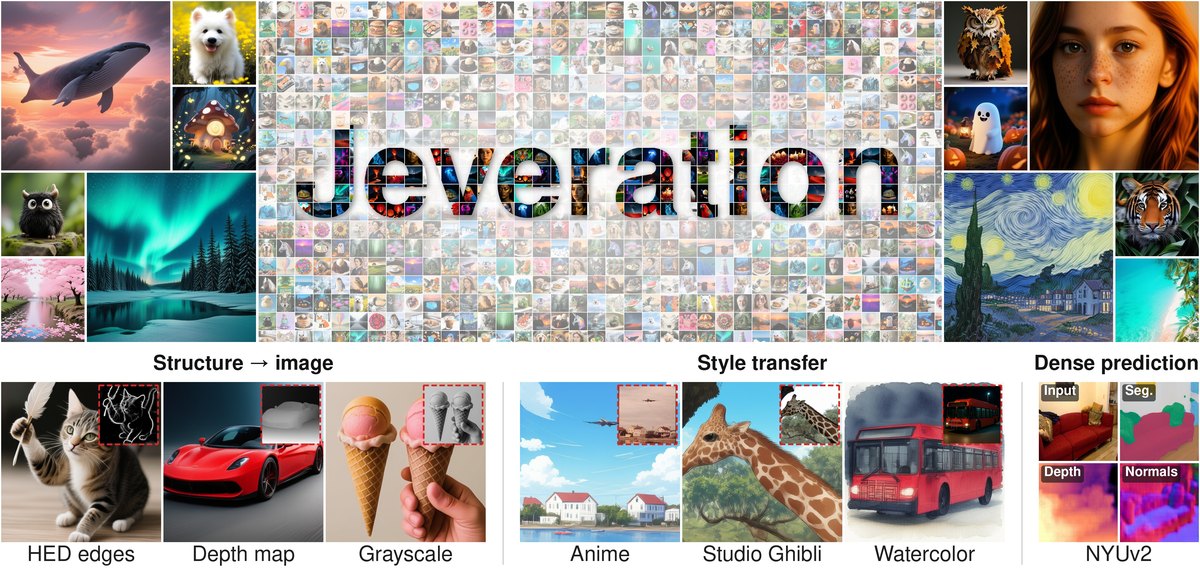
- A single Jeveration model can perform text-to-image generation, image-to-image editing, and complex visual analysis tasks like depth estimation.
- The work was led by Yuhe Liu, Qi Li, Shihua Zhang, and Xinchao Wang at the National University of Singapore. The original study is available on arXiv.
What is Jeveration AI?
Jeveration is a new type of artificial intelligence that creates a full image from a text prompt in one single step, much like a person instantly visualizing a scene in their mind.
It makes a single, parallel decision to produce the entire image at once. The result is stunning speed without sacrificing the quality of the final picture.
How Does Jeveration Work So Fast?
It uses a clever trick with a "shared random state" to coordinate all parts of the image simultaneously, avoiding the need for multiple slow steps.
The core innovation of Jeveration isn't building a bigger AI model from scratch. Instead, the team started with a powerful, pre-trained vision-language model called Qwen3.5-4B—a system already skilled at understanding the relationship between words and images. They kept this model frozen, meaning its billions of learned parameters were left untouched. To give it generative powers, they added only small, trainable components called LoRA adapters and task-specific output heads.
The biggest hurdle was global consistency. A prompt like "a busy street cafe" can lead to many valid images, but if each part of the image is chosen independently, you might get a sunny sky in one corner and a rainy street in another—a visual mess. <figure class="my-10 overflow-hidden border border-slate-800 rounded-2xl bg-white text-slate-100 shadow-xl">

</figure>
To solve this, Jeveration conditions every part of the image on a common shared random state. Think of this like giving every musician in an orchestra the same conductor. This single source of direction ensures that all the parallel decisions—the pixels—work in harmony to create one coherent image on the first try.
Why is This a Hard Problem to Solve?
Because teaching an AI to use that shared random state effectively is very difficult. If trained naively, the model simply learns to ignore it.
The researchers developed a two-phase training process to force the model to learn the importance of coordination. First, they trained it as a "masked model," where it learned to predict missing parts of an image based on the surrounding context. This taught the AI about the dependencies between different image regions.
Then, in the second phase, they used this trained masked model as a guide. It acts as a critic, judging the coherence of the images Jeveration generates from pure randomness. By matching its output to the critic's expectations, Jeveration learns to use the shared random state to produce globally consistent images in one shot. <figure class="my-10 overflow-hidden border border-slate-800 rounded-2xl bg-white text-slate-100 shadow-xl">

</figure>
What Can Jeveration Do Besides Generate Images?
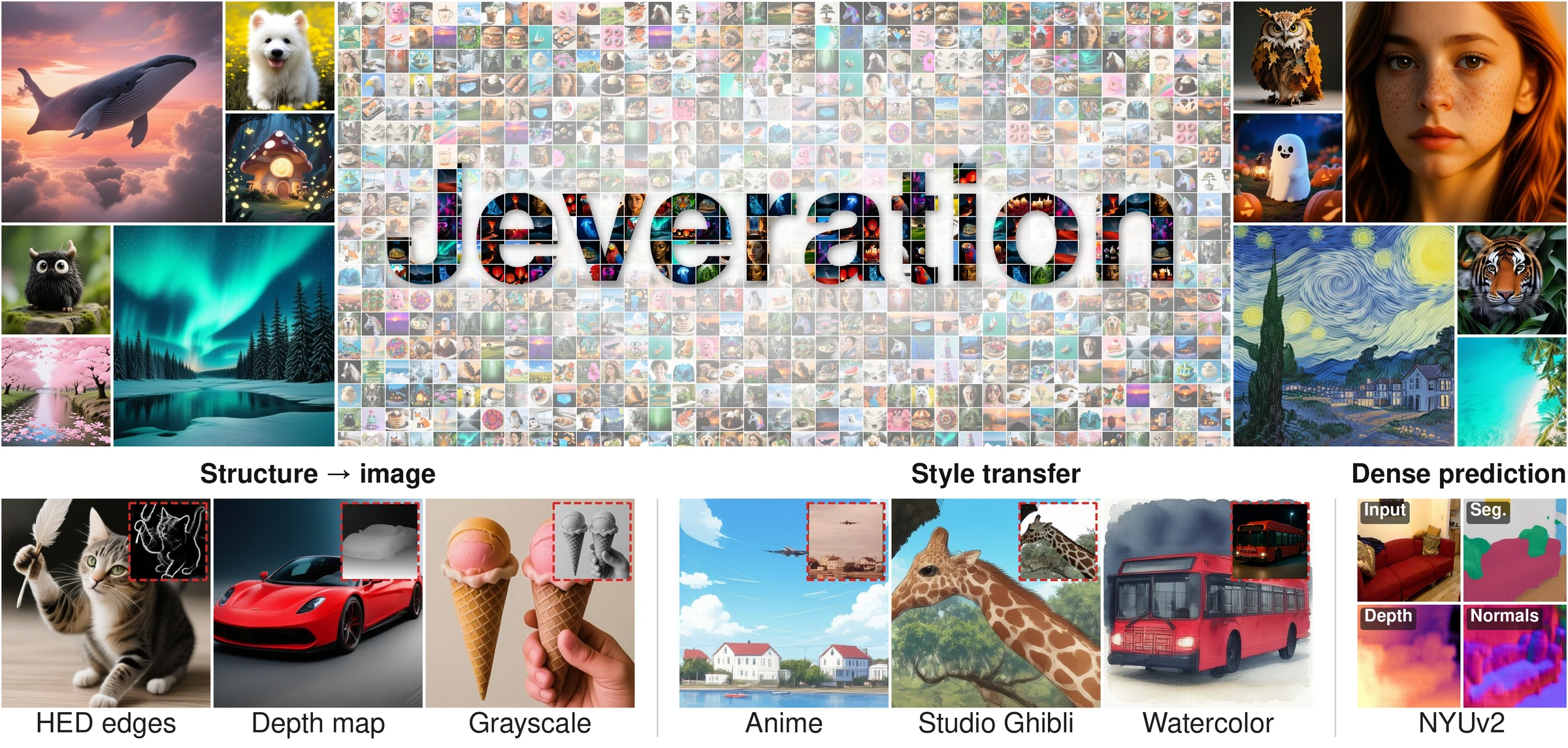
A single Jeveration checkpoint is a multi-tool for visual tasks, handling image generation, editing, and analysis.
One of the most powerful aspects of this research is its unification of three distinct capabilities into one model:
- Text-to-image generation: Creating a new image from a written description.
- Image-to-image generation: Editing an existing image based on instructions (e.g., turning a daytime photo to night).
- Dense prediction: Analyzing an image to produce detailed maps of what's in it, such as segmenting every object or estimating depth.
This means the same underlying AI can both create and critically understand visuals, a significant step toward more general and efficient visual intelligence. This approach of using a single model for multiple complex tasks mirrors advancements in other areas of AI, such as the tool-selection prowess demonstrated in our coverage of Route Anything.
How Fast is Jeveration Really?
The numbers from the paper are clear: it sets a new benchmark for speed in unified AI models.
The team measured performance on a single NVIDIA H200 GPU. Jeveration generated a standard 512x512 pixel image in 78 milliseconds. The authors compare this to Janus-Pro-7B, a large unified model that took 9.5 seconds for the same task—making Jeveration 122 times faster. This speed advantage doesn't come with a major drop in quality. The paper reports a GenEval score of 0.74, which is competitive with other modern generators, and strong performance on dense prediction tasks.
The Bigger Picture: The Race for Instant AI Imagery
Jeveration is part of a broader push in AI research to move away from slow, sequential generation methods.
The current landscape of AI image generation is dominated by two paradigms: autoregressive models (which generate an image token-by-token, like typing a sentence) and diffusion models (which gradually denoise an image from random static over many steps). Both are inherently slow because they require dozens or hundreds of sequential steps.
"We introduce a third paradigm for image generation that removes sequential sampling," Yuhe Liu and colleagues write in the paper.
Research into one-step generation is heating up, with approaches like consistency models and distillation techniques. Jeveration's contribution is unique because it leverages the existing knowledge in large frozen models and the proven architecture of fast decision-making systems. This work connects to the ongoing evolution of AI models that can perform complex, multi-faceted tasks efficiently, a theme we see in agents like magpie. The ultimate goal is seamless, real-time interaction with AI for creative and analytical work.

What Does This Mean for the Future?
This research points toward a future where generating and editing high-quality visuals is as fast as searching the web.
The immediate implication is speed. Applications that rely on rapid visual content creation—from graphic design and marketing to game development and virtual worlds—could be transformed by this order-of-magnitude leap in performance. It makes real-time, interactive AI image generation a tangible possibility.
Furthermore, the efficiency of the approach is notable. By building upon a frozen backbone, Jeveration is a more sustainable and accessible model. It doesn't require retraining a massive model from scratch, which consumes enormous energy. This efficient repurposing of existing models is a promising direction for the field, similar to how robot learning benefits from efficient training frameworks like SLA.
The unification of generation and understanding in one model also hints at future AIs that don't just create blindly but can also critique and refine their own creations based on a deeper understanding of visual content.
Paper, Code and Resources
- Paper: Jeveration: System One Models Now Generate on arXiv (a preprint server; not yet peer reviewed)
- Code: Carol-lyh/Jeveration on GitHub
- Project page: carol-lyh.github.io/Jeveration
- Discussion: Hugging Face Papers — 123 community upvotes as of November 20, 2026
Frequently Asked Questions
How is Jeveration different from DALL-E or Midjourney?
DALL-E and Midjourney primarily use diffusion models, which require many iterative steps to generate an image. Jeveration uses a completely different, single-step approach inspired by fast decision-making systems, resulting in dramatically faster generation times.
Can I use Jeveration right now?
No, this is currently a research project described in an academic paper. The technology is not yet publicly available as a product or service.
Does the speed of Jeveration mean lower quality images?
According to the experimental results in the paper, no. Jeveration maintains competitive image quality scores while achieving its massive speed improvements. The two-phase training process is key to ensuring quality isn't sacrificed.
What is a "frozen model" in AI?
Common examples include semantic segmentation (labeling each pixel with the object it belongs to) and depth estimation (calculating how far away each pixel is from the camera).
Source: Read the original study