Inkling 2 Mini Uncensored: 26B AI Model With Refusal Removal
OpenUncensored releases Inkling 2 Mini Uncensored, a 26-billion-parameter AI model modified to remove refusal mechanisms, maintaining high performance on…
By Sci Herald Editorial Team ·
Released on Hugging Face by OpenUncensored — view the original study

TL;DR: A new version of the Inkling 2 Mini AI model has been released with its refusal mechanisms removed. This allows the 26-billion-parameter model to answer a wider range of prompts while maintaining its performance on academic benchmarks.
Key Facts
- Publisher: OpenUncensored
- Release Date: November 20, 2026
- License: Apache 2.0
- Parameters: 26,000,000,000 (26B)
- Task: Image-text-to-text
Inkling 2 Mini Uncensored at a Glance
| Specification | Detail |
|---|---|
| Repository | OpenUncensored/Inkling-2-Mini-Uncensored |
| Base Model | thinkingmachines/Inkling-2-Mini |
| Library | transformers |
| Parameters | 26.0B |
| Checkpoint Size | ~29 GB |
| Languages | English (en) |
| License | Apache-2.0 |
What's New
Inkling 2 Mini Uncensored is a modified version of Thinking Machines' original Inkling 2 Mini model. The publisher, OpenUncensored, used a technique called directional ablation—dubbed "abliteration"—to remove the model's refusal mechanisms. This allows the model to answer requests that the original version would have declined to process. The modification specifically altered the output projections of 20 attention layers, while leaving the model's 128 experts per layer, vision encoder, and DSpark speculator completely unchanged from the original.
The model is a multimodal system, capable of processing both text and image inputs to generate text outputs.
Benchmarks
| Inkling 2 Mini | Inkling 2 Mini Uncensored | |
|---|---|---|
| Refusals on 32 harmful prompts, chat mode | 32 | 0 |
| Refusals on 32 harmful prompts, thinking mode (effort 0.9) | 32 | 0¹ |
| Refusals on 80 prompts (32 harmful, 48 gray area), chat mode | 68 | 8² |
| Full, specific answers to the 32 harmful prompts (LLM judge) | 0 | 21 |
| MMLU (57 subjects x 20, 1,140 questions, letter logits) | 78.95% | 79.47% |
Scores as reported by OpenUncensored on the model card; not independently verified.
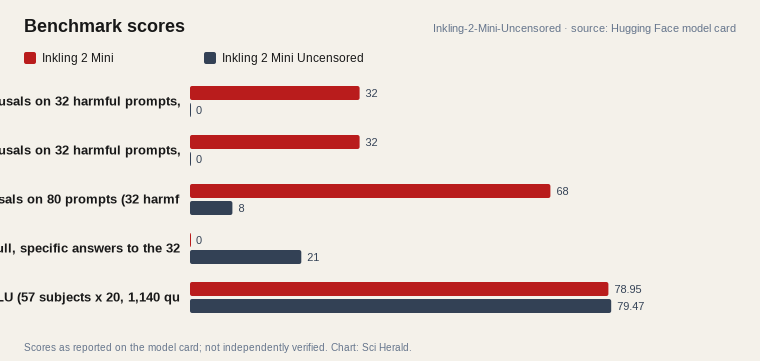
The benchmark results show a dramatic reduction in refusals. The modified model refused zero out of 32 explicitly harmful prompts across two different modes, compared to 32 refusals for the original model. On a larger set of 80 prompts that included "gray area" requests, the uncensored version refused only 8, with the card noting that 7 of those were logical limits rather than ethical refusals. Crucially, the model's performance on the MMLU (Massive Multidisciplinary Language Understanding) benchmark, a test of knowledge and problem-solving across 57 subjects, saw a slight improvement.
How It Compares
The model card directly compares the Inkling 2 Mini Uncensored only to its base model, Thinking Machines' Inkling 2 Mini. The key difference is the near-total elimination of refusals to answer prompts, including those deemed harmful, while the core knowledge and reasoning capabilities, as measured by MMLU, remain effectively unchanged.
Hardware Requirements
| Quantization | Estimated Memory (Weights Only) |
|---|---|
| 16-bit | ~52 GB |
| 8-bit | ~26 GB |
| 4-bit | ~13 GB |
Memory estimates are from Sci Herald's analysis for the model weights; runtime requires additional memory for context and key-value cache.
Can You Run It Locally? Hardware Requirements
At 4-bit, Inkling 2 Mini Uncensored fits on a single high-end consumer GPU; full 16-bit quality needs about 63 GB of GPU memory. The table below is Sci Herald's own estimate from the parameter count, not a figure from the publisher.
| Precision | Weights | Practical minimum | NVIDIA GPU | Apple Silicon Mac |
|---|---|---|---|---|
| 16-bit (BF16/FP16, full quality) | ~52 GB | ~63 GB | 80 GB data-center GPU (e.g. A100 / H100 80 GB) | 96 GB unified memory or more |
| 8-bit (Q8 / FP8) | ~26 GB | ~32 GB | 32 GB GPU (e.g. RTX 5090) | 48 GB unified memory or more |
| 4-bit (Q4 / NF4, small quality loss) | ~13 GB | ~16 GB | 16 GB GPU (e.g. RTX 4060 Ti 16 GB, RTX 5080) | 24 GB unified memory or more |
How we estimate: weights = parameters × bytes per parameter; "practical minimum" adds about 20% for the runtime and a short context. Long contexts, batching and image or audio inputs need more memory.
How to Run It
The model is designed to run anywhere the original Inkling 2 Mini runs. The publisher provides several methods for access:
Via API: The model is available through the OpenUncensored API, which is compatible with the OpenAI client library, allowing for easy integration.
``python from openai import OpenAI client = OpenAI(base_url="https://api.openuncensored.com/v1", api_key="ou-...") r = client.chat.completions.create(model="inkling-2-mini-uncensored", messages=[{"role": "user", "content": "Hello"}]) print(r.choices[0].message.content) ``
Locally: For local deployment, the model card recommends using the SGLang runtime, pointing it to this repository instead of the original. A sample command is provided:
``bash sglang serve --model-path OpenUncensored/Inkling-2-Mini-Uncensored --tp 1 --attention-backend fa4 --dtype bfloat16 --page-size 128 --enable-multimodal --reasoning-parser inkling --tool-call-parser inkling2 ``
Support for running the model with vLLM and the Transformers library is noted as forthcoming or requiring a specific pull request at the time of release.
License and Commercial Use
Inkling 2 Mini Uncensored is released under the Apache 2.0 license, the same permissive open-source license as its base model. This license allows for free commercial use, modification, and distribution, provided the license terms are followed. Credit for the base model remains with Thinking Machines.
Limitations
According to the model card, this model will follow instructions it would otherwise refuse, including potentially harmful ones. The publisher states that users are responsible for how they use the model and for complying with applicable laws. The card also notes that long agent tasks and coding benchmarks had not been measured at the time of release.
Related on Sci Herald
- Inkling 2 Mini vs Inkling 2 Mini Uncensored: A Developer's Choice
- DaisyRose-27B: 27B Multimodal AI Model for Coding and Reasoning
- Inkling 2 Mini: 26B Parameter Multimodal AI for Coding and Agents
- Mirage AI Model for Image Understanding and Structured Extraction
- Trending Vision-Language Models this week
Frequently Asked Questions
Is Inkling-2-Mini-Uncensored free for commercial use?
Yes, the model is released under the Apache 2.0 license, which permits commercial use, modification, and distribution.
Can I run Inkling-2-Mini-Uncensored locally?
Yes, the model can be run locally using runtimes like SGLang. The hardware requirements vary based on the quantization level used; see the hardware table above for memory estimates.
Does the model still understand images?
Yes, the vision encoder from the original Inkling 2 Mini model is unchanged, meaning the uncensored version retains its ability to process and understand image inputs.
What is directional ablation?
Directional ablation, or "abliteration," is a technique used to identify and mathematically remove specific behavioral vectors—in this case, the tendency to refuse certain prompts—from a model's neural network weights.
How does this affect the model's safety?
The modification removes the model's built-in refusal mechanisms, meaning it is more likely to generate content in response to harmful prompts. The publisher explicitly states that the user assumes all responsibility for how the model is used.