Inkling 2 Mini: 26B Parameter Multimodal AI for Coding and Agents
Thinking Machines releases Inkling 2 Mini, a 26.4B parameter multimodal AI model on Hugging Face, designed for coding, tool use, and agentic applications…
By Sci Herald Editorial Team ·
Released on Hugging Face by thinkingmachines — view the original study

TL;DR: Thinking Machines has released Inkling 2 Mini, a 26.4-billion-parameter multimodal AI model on Hugging Face. The model is designed for developers building applications that require understanding both text and images, particularly for coding assistance and autonomous AI agents.
Key Facts
- Repository: Available on Hugging Face
- Release Date: November 17, 2026
- License: Apache 2.0, allowing for commercial use
- Parameters: 26.4 billion total, with 5.4 billion active per token
- Task: Image-text-to-text processing
Inkling 2 Mini at a Glance
| Specification | Detail |
|---|---|
| Parameters | 26.4B |
| Active Parameters per Token | 5.4B |
| Checkpoint Size | ~29 GB |
| Context Window | Up to 1M tokens |
| Input Modalities | Text, Images |
| Output Modalities | Text |
| Library | Transformers |
What's New
Inkling 2 Mini is a general-purpose multimodal model that accepts both text and image inputs to generate text outputs. It is designed for use in English and other languages, and across multiple coding languages. The model is intended for developers building AI-powered applications, including agentic and tool-use systems, coding assistants, chatbots, and retrieval-augmented generation systems.
This release introduces a novel "looped transformer" architecture, where the middle 12 layers run three times with shared weights, providing 48 layer applications per token from just 24 layers of weights. This design allows for more computation per token without increasing the model's physical size. It is the first looped transformer released by Thinking Machines.
Benchmarks
| Inkling 2 Mini | Gemma 4 31B | Muse Glimmer | Qwen3.8-27B | Nemotron 3.5 Super VL | |
|---|---|---|---|---|---|
| AA Index (v5.0) | 20.1 | 4.4 | 6.3 | 20.1 | 13.6 |
| FrontierCode v2.0 | 15.1% | 0.0% | 1.5% | 14.9% | 6.1% |
| DeepSWE v1.1 | 48.2% | 0.3% | 4.4% | 42.2% | 24.7% |
| SWEBench Pro v2 (Hard) | 77.9% | 14.2% | 44.3% | 73.8% | 44.1% |
| BrowseComp | 79.0% | 37.0% | 63.9% | 61.6% | 78.9% |
| DeepSearchQA | 85.3% | 61.7% | 74.6% | 79.7% | 77.7% |
| AA-Briefcase v1.1 | 1263 | 369 | 478 | 1391 | 999 |
Scores as reported by thinkingmachines on the model card; not independently verified.
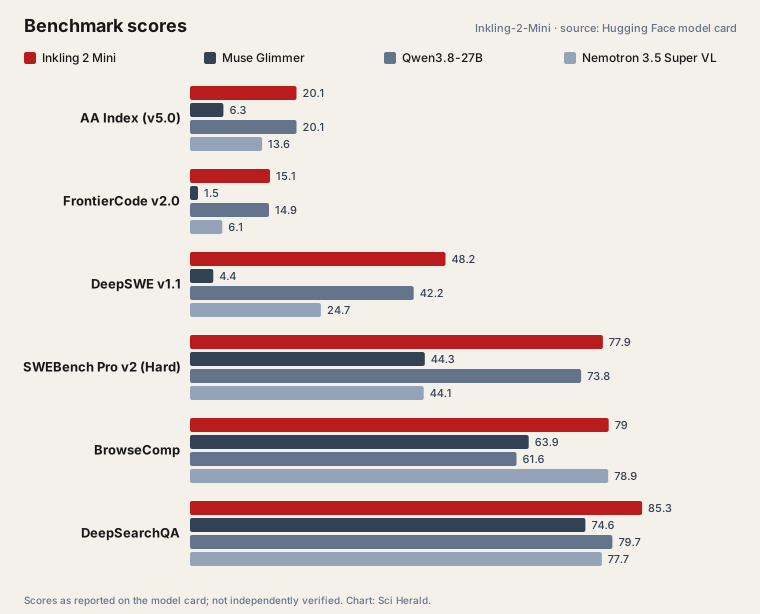
The benchmark results show Inkling 2 Mini performs competitively in coding and agentic tasks. It achieves particularly strong results on the DeepSearchQA (85.3%) and SWEBench Pro v2 Hard (77.9%) evaluations, outperforming several comparable models in agentic search and coding capabilities.
How It Compares
According to the provided benchmarks, Inkling 2 Mini shows competitive performance against similar-sized models like Qwen3.8-27B and significantly outperforms larger models like Gemma 4 31B in coding and agentic tasks. It demonstrates particular strength in software engineering benchmarks (SWEBench), coding tasks (FrontierCode, DeepSWE), and agentic search capabilities (BrowseComp, DeepSearchQA).
Hardware Requirements
| Quantization | Estimated Memory (Weights Only) |
|---|---|
| 16-bit | ~53 GB |
| 8-bit | ~27 GB |
| 4-bit | ~14 GB |
Memory estimates are Sci Herald's own for weights only; runtime requires additional memory for context/KV cache.
The publisher recommends 32GB or more of VRAM for optimal performance. The model can run on various hardware including:
- 1x NVIDIA DGX Spark
- Apple silicon devices with 32GB or more memory
- Other GPUs with 32GB or more VRAM
Can You Run It Locally? Hardware Requirements
At 4-bit, Inkling 2 Mini fits on a single high-end consumer GPU; full 16-bit quality needs about 64 GB of GPU memory. The table below is Sci Herald's own estimate from the parameter count, not a figure from the publisher.
| Precision | Weights | Practical minimum | NVIDIA GPU | Apple Silicon Mac |
|---|---|---|---|---|
| 16-bit (BF16/FP16, full quality) | ~53 GB | ~64 GB | 80 GB data-center GPU (e.g. A100 / H100 80 GB) | 96 GB unified memory or more |
| 8-bit (Q8 / FP8) | ~27 GB | ~32 GB | 32 GB GPU (e.g. RTX 5090) | 48 GB unified memory or more |
| 4-bit (Q4 / NF4, small quality loss) | ~14 GB | ~16 GB | 16 GB GPU (e.g. RTX 4060 Ti 16 GB, RTX 5080) | 24 GB unified memory or more |
How we estimate: weights = parameters × bytes per parameter; "practical minimum" adds about 20% for the runtime and a short context. Long contexts, batching and image or audio inputs need more memory.
How to Run It
Inkling 2 Mini supports multiple inference frameworks. The model is available through the Hugging Face transformers library and can be accessed using several popular runtimes:
- Hugging Face Transformers
- SGLang
- vLLM
- TokenSpeed
- NVIDIA Dynamo
- Unsloth (including quantized GGUF versions)
- llama.cpp
- Llama App
- Ollama and Exo Labs (on Apple silicon)
For fine-tuning, the model supports:
- Miles
- SkyRL
The publisher also provides API access through their Tinker fine-tuning platform and a playground for inference-only access.
License and Commercial Use
Inkling 2 Mini is released under the Apache 2.0 license, which allows for both research and commercial use. Developers can fine-tune and integrate the model into third-party products without restrictions typically associated with non-commercial licenses.
Limitations
The model card outlines several limitations specific to Inkling 2 Mini:
- Knowledge and factual accuracy: The model is less capable than larger models like Inkling 2 Small on factual recall and knowledge-heavy questions, and may state incorrect information with confidence.
- Repetitive reasoning: The model can sometimes become stuck in long reasoning loops, particularly when debugging code.
- Agentic reliability: When using tools, it may take destructive actions without confirmation and may not report outcomes accurately.
- Language performance: Output quality can be lower outside of English, with observed issues including clipped phrasing and mixed languages.
- Sensitive topics: The model may respond with excessive caution when conversations touch on mental health topics.
The publisher recommends implementing additional safeguards, human oversight, and sandboxing for agentic workloads, particularly for high-stakes applications.
Related on Sci Herald
- Mirage AI Model for Image Understanding and Structured Extraction
- Inkling 2 Small: A 594B Parameter Open Multimodal AI for Coding and Agents
- Kimi K3.1 Pro: A 2.8 Trillion Parameter Multimodal AI Agent
- Trending Vision-Language Models this week
Frequently Asked Questions
Is Inkling 2 Mini free for commercial use?
Yes, Inkling 2 Mini is released under the Apache 2.0 license, which permits both research and commercial use without additional licensing fees.
Can I run Inkling 2 Mini locally?
Yes, the model is designed to run on local hardware. It requires a high-end consumer GPU with sufficient VRAM, with 32GB recommended for optimal performance across different quantization levels.
What makes Inkling 2 Mini different from other models?
Inkling 2 Mini uses a novel looped transformer architecture where middle layers run multiple times, providing more computation per token without increasing parameter count. It's specifically optimized for multimodal understanding and agentic tasks.
What programming languages does Inkling 2 Mini support?
The model supports multiple coding languages and is particularly strong in software engineering tasks, though specific language support isn't detailed in the model card.
Does Inkling 2 Mini require special software to run?
The model works with standard AI inference frameworks including Hugging Face Transformers, vLLM, and llama.cpp, though optimal performance may require frameworks that support its looped architecture.