Inkling 2 Small: A 594B Parameter Open Multimodal AI for Coding and Agents
Thinking Machines releases Inkling 2 Small, a 594-billion parameter open-source multimodal AI model on Hugging Face, designed for image-text-to-text tasks…
By Sci Herald Editorial Team ·
Released on Hugging Face by thinkingmachines — view the original study

TL;DR: Thinking Machines has released Inkling 2 Small, a massive open-source multimodal AI model on Hugging Face. This model, which processes both images and text, is designed for developers building advanced applications like coding assistants and AI agents.
Key Facts
- Released on Hugging Face by thinkingmachines on November 4, 2026.
- A 594-billion parameter multimodal model for image-text-to-text tasks.
- Licensed under Apache 2.0 for open research and commercial use.
- Downloaded 3,647 times in the last 30 days and liked 321 times.
- Requires significant hardware, with a checkpoint size of approximately 602 GB.
Inkling 2 Small at a Glance
| Property | Specification |
|---|---|
| Repository | thinkingmachines/Inkling-2-Small |
| Task | Image-Text-to-Text |
| Library | Transformers |
| Total Parameters | 594B |
| Active Parameters | 17B |
| Context Window | 1M tokens |
| Input Modalities | Text, Images |
| License | Apache-2.0 |
What's New
Inkling 2 Small is a general-purpose multimodal model that accepts both text and image inputs to generate text outputs. It is intended for use in English and other languages, and across multiple coding languages. The publisher states it is designed for developers building AI-powered applications, including agentic and tool-use systems, coding assistants, chatbots, and retrieval-augmented generation systems. It is released with open weights to support research, fine-tuning and integration into third-party products.
Benchmarks
| Inkling 2 Small | DeepSeek-V4.1-Flash-1017 | Claude Haiku 5.5 | |
|---|---|---|---|
| Coding | |||
| FrontierCode v2.0 | 25.4% | 28.5% | 34.9% |
| DeepSWE v1.1 | 72.1% | 77.0% | 59.9% |
| Vibe Code Bench v1.1 | 81.6% | 87.7% | 90.4% |
| Search and Tools | |||
| BrowseComp | 90.2% | 87.8% | 80.2% |
| DeepSearchQA | 90.9% | 84.5% | 83.2% |
Scores as reported by thinkingmachines on the model card; not independently verified.
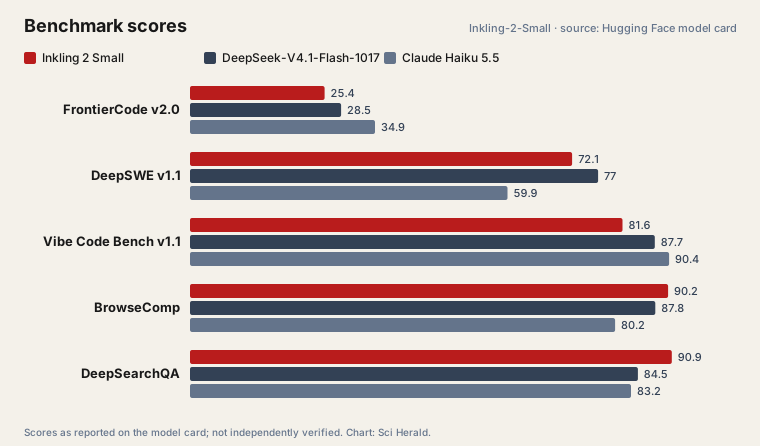
The provided benchmark table compares Inkling 2 Small against other models. In coding tasks, it shows competitive performance, particularly on the Vibe Code Bench and DeepSWE evaluations. For search and tool-use benchmarks like BrowseComp and DeepSearchQA, Inkling 2 Small scores among the highest reported results.
How It Compares
The model card includes a comprehensive comparison table pitting Inkling 2 Small against other open and closed models like GLM-5.3-Flash, MiniMax-M3.1-Flash, DeepSeek-V4.1-Flash-1017, and Claude Haiku 5.5. The benchmarks cover coding, autoresearch, search and tools, and knowledge work. Inkling 2 Small is positioned as a strong contender in the open-weights category, achieving top-tier results in several tool-use and search-oriented tasks.
Hardware Requirements
| Checkpoint Format | Minimum Aggregated VRAM | Example GPU Configuration |
|---|---|---|
| NVFP4 (Recommended) | 500 GB | 2x NVIDIA B300 or 4x NVIDIA H200 |
| MXFP8 | 800 GB | 4x NVIDIA B300 or 8x NVIDIA H200 |
Runtime memory needs will be higher than the weights-only estimates below to account for context and KV cache.
| Quantization | Sci Herald Memory Estimate (Weights Only) |
|---|---|
| 16-bit | ~1188 GB |
| 8-bit | ~594 GB |
| 4-bit | ~297 GB |
Can You Run It Locally? Hardware Requirements
Inkling 2 Small needs multiple data-center GPUs at any precision — most people will use it through a hosted API instead. The table below is Sci Herald's own estimate from the parameter count, not a figure from the publisher.
| Precision | Weights | Practical minimum | NVIDIA GPU | Apple Silicon Mac |
|---|---|---|---|---|
| 16-bit (BF16/FP16, full quality) | ~1188 GB | ~1426 GB | Multi-GPU: about 18× 80 GB GPUs | Not practical on a single Mac |
| 8-bit (Q8 / FP8) | ~594 GB | ~713 GB | Multi-GPU: about 9× 80 GB GPUs | Not practical on a single Mac |
| 4-bit (Q4 / NF4, small quality loss) | ~297 GB | ~357 GB | Multi-GPU: about 5× 80 GB GPUs | 512 GB unified memory or more |
How we estimate: weights = parameters × bytes per parameter; "practical minimum" adds about 20% for the runtime and a short context. Long contexts, batching and image or audio inputs need more memory.
How to Run It
According to the model card, Inkling 2 Small supports local inference using several popular frameworks, including SGLang, vLLM, TokenSpeed, and Unsloth. The card provides specific recipes for each framework on their respective documentation sites. For developers not wishing to manage hardware, API access is available through third-party inference providers like NVIDIA, Fireworks, Together, Baseten, and Cloudflare Workers AI. The publisher recommends using the NVFP4 checkpoint for all use cases.
License and Commercial Use
Inkling 2 Small is released under the Apache-2.0 license. This permissive open-source license allows for both research and commercial use, including fine-tuning and integration into third-party products.
Limitations
The model card details several limitations. Inkling 2 Small may exhibit common issues like hallucination (generating incorrect information), occasional failures to follow instructions, and degraded performance in long conversations. It may also reflect biases present in its web-derived training data and has a knowledge cutoff based on its training data. The publisher recommends that developers conduct their own evaluations for specific use cases, implement additional safeguards for open deployments, and avoid using the model for medical, legal, or safety-critical decision-making without further validation and human oversight.
Related on Sci Herald
- MiniMax M3.1 Flash vs Inkling 2 Small: Specs, Benchmarks and Use Cases
- Kimi K3.1 Pro: A 2.8 Trillion Parameter Multimodal AI Agent
- MiniCPM-OCR 1.0: 1.3B AI Model for Document Text Extraction and Understanding
- MiniMax M3.1 Flash: 428B MoE Multimodal AI for Coding and Agents
- Trending Vision-Language Models this week