DaisyRose-27B: 27B Multimodal AI Model for Coding and Reasoning
RadixArk's DaisyRose-27B is a 27.8B parameter multimodal AI model for image and text understanding, released on Hugging Face under an Apache 2.0 license.
By Sci Herald Editorial Team ·
Released on Hugging Face by RadixArk — view the original study

TL;DR: RadixArk has released DaisyRose-27B, a large multimodal AI model for understanding both text and images. It is a drop-in replacement for the popular Qwen3.8-27B model, offering improved performance on coding and reasoning tasks and is freely available for commercial use.
Key Facts
- Released on Hugging Face by RadixArk on November 18, 2026.
- A 27.8 billion parameter multimodal model for image-text-to-text tasks.
- Licensed under Apache 2.0, allowing for commercial use.
- Achieved 2,130 downloads in its first 30 days on the platform.
- Trained exclusively with reinforcement learning on 1,200 curated long-horizon agent tasks.
DaisyRose-27B at a Glance
| Property | Value |
|---|---|
| Publisher | RadixArk |
| Parameters | 27.8B |
| Base Model | Qwen/Qwen3.8-27B |
| Context Length | 262,144 tokens |
| Input Modalities | Text, Images |
| License | Apache-2.0 |
| Library | Transformers |
What's New
DaisyRose-27B is the first model from publisher RadixArk. It is a multimodal reasoning model built directly on top of Qwen3.8-27B. Uniquely, it was trained using only reinforcement learning, without any supervised fine-tuning or knowledge distillation. The training focused on approximately 1,200 carefully curated long-horizon agent tasks, with some training sessions spanning up to one million tokens. The 18-day training process required 144 H200 GPUs, consuming an estimated 63,000 GPU-hours.
A key advantage for developers is that DaisyRose-27B maintains the base model's architecture, tokenizer, and chat template. This includes its image understanding capabilities and substantial 262,144-token context window, making it a direct drop-in replacement for Qwen3.8-27B in existing inference setups.

Benchmarks
The model card provides detailed benchmark scores comparing DaisyRose-27B against its base model and other prominent open and closed models.
| Benchmark | DaisyRose-27B | Qwen3.8-27B | Muse Glimmer-30B | MiMo V2.6 Flash | Inkling 2 Small | GPT-6 Luna |
|---|---|---|---|---|---|---|
| Terminal Bench 4.1 | 12.0 | 5.6 | 0.5 | 16.1 | 13.0 | 15.2 |
| Terminal Bench 2.1 | 75.5 | 73.0 | 51.7 | 87.6 | 81.3 | 73.0 |
| DeepSWE v1.1 | 46.2 | 42.2 | 4.4 | 67.9 | 72.1 | 66.6 |
| SWE Bench Pro v2 | 94.7 | 91.3 | 80.4 | – | 97.7 | – |
| IFBench | 82.4 | 79.5 | 77.0 | – | – | – |
Scores as reported by RadixArk on the model card; not independently verified.
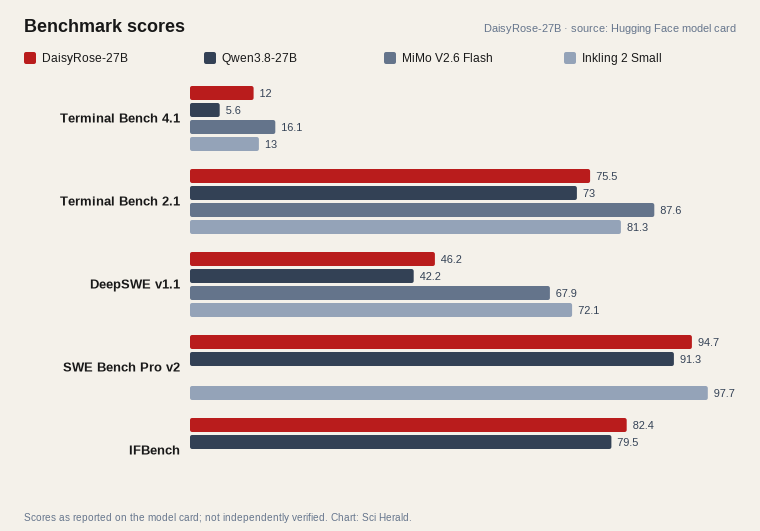
The results show that DaisyRose-27B delivers a substantial performance uplift over its base model, Qwen3.8-27B, across nearly all evaluated benchmarks. Most notably, its score on Terminal Bench 4.1 more than doubled from 5.6 to 12.0. It also leads in instruction-following (IFBench) against the compared models. While it does not top every chart—being outperformed by larger models like MiMo V2.6 Flash and Inkling 2 Small on some coding tasks—its performance is highly competitive for its parameter count.
Recommended Settings
For optimal performance in its default "thinking mode," the publisher recommends the following generation settings:
temperature: 1.0top_p: 0.95top_k: 20min_p: 0.0
These settings control the randomness and selectivity of the model's output generation during its reasoning process. For complex problems, it is advised to leave the max_tokens parameter unset, as the model's internal thinking can run to tens of thousands of tokens before producing a final answer.
How It Compares
As the benchmark table illustrates, DaisyRose-27B sits in a competitive space among models designed for complex reasoning and coding tasks. It consistently outperforms its direct predecessor, Qwen3.8-27B. When compared to other models, it holds its own against much larger systems; for example, it is competitive with the 42B parameter Muse Spark Open on several benchmarks and even outperforms the massive 501B parameter Beam 1.0 model on Terminal Bench 4.1 and IFBench. This demonstrates a high level of efficiency and performance per parameter.
Hardware Requirements
| Precision | Estimated VRAM (Weights Only) |
|---|---|
| 16-bit (BF16) | ~56 GB |
| 8-bit | ~28 GB |
| 4-bit | ~14 GB |
Memory estimates are our own for the model weights; runtime requires additional memory for context and key-value cache.
Can You Run It Locally? Hardware Requirements
At 4-bit, DaisyRose-27B fits on a single high-end consumer GPU; full 16-bit quality needs about 67 GB of GPU memory. The table below is Sci Herald's own estimate from the parameter count, not a figure from the publisher.
| Precision | Weights | Practical minimum | NVIDIA GPU | Apple Silicon Mac |
|---|---|---|---|---|
| 16-bit (BF16/FP16, full quality) | ~56 GB | ~67 GB | 80 GB data-center GPU (e.g. A100 / H100 80 GB) | 96 GB unified memory or more |
| 8-bit (Q8 / FP8) | ~28 GB | ~34 GB | 48 GB GPU (e.g. RTX 6000 Ada) or 2× 24 GB | 48 GB unified memory or more |
| 4-bit (Q4 / NF4, small quality loss) | ~14 GB | ~17 GB | 24 GB GPU (e.g. RTX 4090, RTX 3090) | 24 GB unified memory or more |
How we estimate: weights = parameters × bytes per parameter; "practical minimum" adds about 20% for the runtime and a short context. Long contexts, batching and image or audio inputs need more memory. For mixture-of-experts models, all experts must be in memory even though only some are active per token.
How to Run It
The publisher strongly recommends serving DaisyRose-27B using the SGLang runtime paired with DSpark speculative decoding for optimal performance. This is done via a Docker container. A complete launch command for a 4-GPU node is provided in the model card. For a quick start, you can use the OpenAI client library to query a running server.
```python from openai import OpenAI
client = OpenAI(base_url="http://localhost:30000/v1", api_key="none") SAMPLING = dict(temperature=1.0, top_p=0.95, extra_body={"top_k": 20, "min_p": 0.0})
resp = client.chat.completions.create( model="DaisyRose-27B", messages=[{"role": "user", "content": "How many positive divisors does 360 have?"}], **SAMPLING, ) print(resp.choices[0].message.reasoning_content) # thinking print(resp.choices[0].message.content) # final answer ```
License and Commercial Use
DaisyRose-27B is released under the permissive Apache 2.0 license. This means it is free for both personal and commercial use, including modification and distribution, with minimal restrictions.
Limitations
The model card does not provide a specific list of limitations or potential failure modes. As with any AI model, users are advised to evaluate its performance thoroughly on their own specific tasks and data to understand its capabilities and constraints before deploying it in a production environment.
Related on Sci Herald
- Inkling 2 Mini vs DaisyRose-27B: A Developer's Practical Comparison
- Inkling 2 Mini Uncensored: 26B AI Model With Refusal Removal
- Inkling 2 Mini: 26B Parameter Multimodal AI for Coding and Agents
- Mirage AI Model for Image Understanding and Structured Extraction
- Trending Vision-Language Models this week
Frequently Asked Questions
Is DaisyRose-27B free for commercial use?
Yes, DaisyRose-27B is released under the Apache 2.0 license, which permits free commercial use, modification, and distribution.
Can I run DaisyRose-27B on a single GPU?
Yes, the model can run on a single high-end consumer or professional GPU when using quantization. See the hardware table above for estimated memory requirements at different precision levels.
What is the difference between DaisyRose-27B and Qwen3.8-27B?
DaisyRose-27B is built directly on Qwen3.8-27B but was further trained using reinforcement learning. This training significantly improved its performance on coding and reasoning benchmarks while maintaining full compatibility as a drop-in replacement.
Does DaisyRose-27B support image inputs?
Yes, as a multimodal model, DaisyRose-27B can accept both text and images as input, processing them to generate text-based responses.
What libraries are needed to run DaisyRose-27B?
The model is built for the Transformers library. The publisher recommends using the SGLang runtime with DSpark speculative decoding for the best performance during serving.